
Tre gurus


Happy birthday :)


Lama Michel Rinpoche, May 1st 2020, Milan, Italy (edited)
“Panchen Lamaen sagde en gang til mig, at det var nemt at være en lama i Østen, fordi kulturen var sådan, at man var respekteret, fik offergaver osv. De rigtige helte var folk som Lama Gangchen som tog til Vesten, hvor man ikke fra start havde traditionel respekt. F.eks. da Rinpoche kom til Vesten startede han med healing af mennesker, f.eks. med at puste på deres krop. Det syntes folk var mærkelig, og de sagde lidt respektløst: det kan jeg også, og de pustede tilbage. Men ugen efter kom de igen og bad om at blive pustet på igen !
Rinpoche saw quickly that people did not love themselves and did not believe in themselves, so how could they love and believe in a guru? He started by teaching them only Shakyamuni's Mantra, OM MUNI MUNI MAHA MUNI SHAKYAMUNI SOHA, so much so that some people came to call him “One-Mantra-Lama”.
But this mantra has incredibly deep meanings.
OM is a union of three sounds, a o ma, representing the body, speech and mind. It also represent the gross, subtle and very subtle mind.
MUNI means capacity, so Capacity, Capacity
MAHA MUNI means Great Capacity
SHAKYA MUNI means the capable one of the Shakyas, that is Supreme Capacity
SOHA means So be it.
The first capacity is: love yourself ! We know some things are good for us, some things are bad for us. Choose what's good for you and discard what's bad for you. Both habits, things, emotions, food, and even sometimes people. Every day, remove one bad thing, add one good thing. Abandon what is harmful and cultivate what is beneficial.
The second capacity is: love others ! Be a real dharma practitioner, and not an actor. One day we will be dead, much sooner than we think. Help others ! Not by being a helper (that is the ego: I’m a big helper), but by helping. Reciting is important, meditating is important, but much more important is helping others.
The Great Capacity relates to seeing reality correctly, emptiness.
Supreme Capacity is Vajrayana's capacity: transforming the five negative emotions into the five wisdom consciousnesses and the five impure elements into the five pure ones.
Tro på dig selv ! Den eneste grund til at de utrolig store Guruer er der og arbejder så hårdt for os, er fordi DE tror på os. Hvis sådanne store væsener tror på os, bør vi så ikke også tro på os selv? Hvis de ikke troede på os, blev de i deres hule for at meditere. Ha’ en slags stolthed, uden arrogance, at du har mødt denne fantastisk store guru: du har alt det du har brug for, redskaberne, velsignelserne, eksemplerne. Tro på dig selv, og gør Rinpoche stolt af os.”
LMR, 01/05/2020
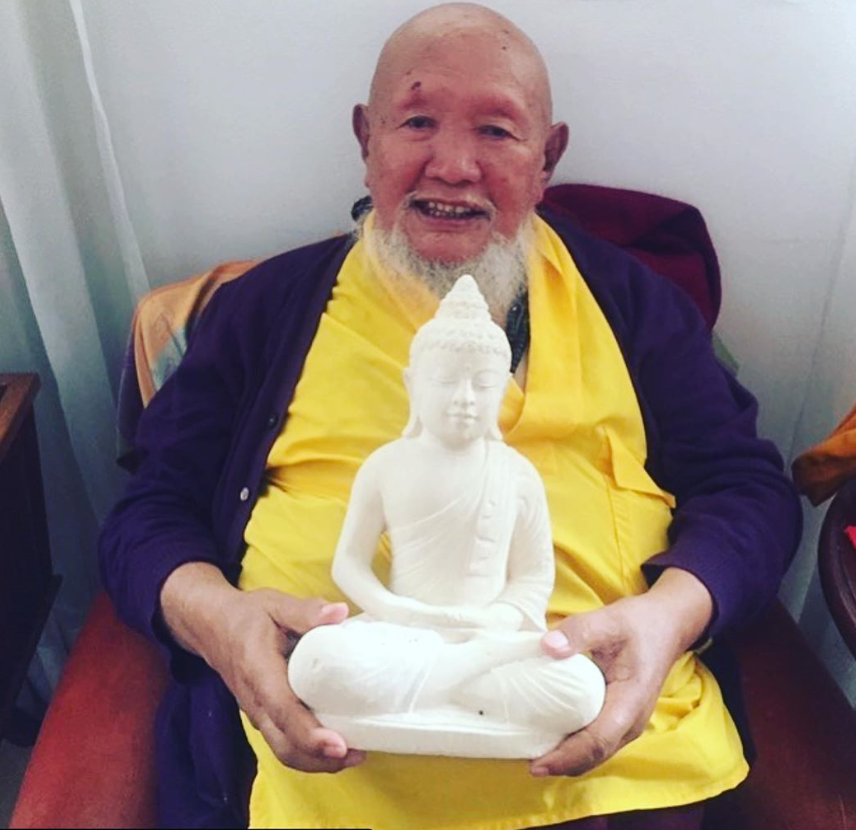
Lama Michel Rinpoche, Kunpen Lama Gangchen, Milan, Italy, 29. april 2020
Rinpoches liv i Vesten kan opdeles i perioder på 10 år. Han dedikerede de første ti år i Vesten til kroppen (ca. 1981-1991), hvor Han healede mange mennesker. Men i stedet for, at mennesker bare skulle heales af lamaen, ventende på hver gang lamaen kom forbi, ville Han gerne lære mennesker, hvordan de kunne heale sig selv.
Så de næste ti år brugte han på talen (ca. 1992-2002), hvor han underviste os i Ngalso Tantrisk Selv-Healing og utrolig mange andre forskellige buddhistiske praksisser.
Det næste årti blev brugt på sindet (ca. 2003-2012), hvor han tog hans disciple ved hånden for at vise, hvordan man lavede disse praksisser. Næsten som en børnehavelærer, som viser børnene, hvad der er undervist, ved at gøre det sammen.
Nu er børnene ved at være mere modne, hvor de selv kan gøre tingene. Det er vores ansvar at praktisere, hvad Rinpoche har lært og vist os, og give det videre.
LMR, 29/4/2020

Based on a video, where Lama Michel Rinpoche answers questions, December 4th 2019
"When we die, there is something that continues. From my understanding, what continues, is the deepest aspect of ourselves. Even in this life, since we were very small kids, as we grow up and get older, there is some part of us that continues. When we know someone really well, and have the sensibility to look at a person, and to know the deepest aspects of their character, of the person, we can see the specific characteristics of the character, of the person, independently of the age, of the time, independent of the context. Once I know you really well, once I know the subtle aspects of your self, imagine that I could recognize you in another body. When we die, we lose the body, the gross aspects, our knowledge etc, but the deeper aspect of the self continues from life to life. So if I know you well enough and I have the sensibility to recognize the deeper aspects of your self, then I can recognize you in another body.
So when a lama dies, the person who has the responsibility to recognize the reincarnation are the people most near to him. It is very sensitive, very deep, it goes very much beyond words, it cannot be put into conceptual understanding, there is no step 1, step 2, step 3, and it is not based on external tests. There are things that are done to recognize lama’s, from external signs, to dreams and so on, but the most important thing for the ones who are searching, is to see on the deepest level the same qualities, the same characteristics, the same person.
Why do we look for the reincarnation of our masters? Each and every one of us, when we are reborn, we take with us our qualities and our faults, like seeds in our subtle mind, our mental continuum, the imprints of our character. When we are born, these are like seeds in a field, waiting for the right conditions to ripen. So if we give a child certain conditions, certain seeds will ripen. That’s why it is so important in Tibetan Buddhism, when someone is reborn with such high qualities, to recognize them, so that we make sure they are given the best conditions for these seeds to ripen. That is the mean reason. The other reason is that the greatest qualities we are looking for in someone to guide us spiritually is not knowledge, but truly love and wisdom. And the deepest state of love and wisdom is something than can be taken from life to life. It is not something that you can gain by study, not something that you can gain by experience, but by an inner process of realization, which can be taken from life to life."
LMR, 04/12/2019